General Relativistic cosmological simulations and observations
General Relativity (GR) is the foundation of modern cosmology. However, traditional cosmological simulations are mostly "Newtonian", in the sense that "simulation particles" are evolved under the action of Newtonian gravity. In this limit of weak gravity and slow motion, neglecting general relativistic effects is usually a good approximation in practice.
Nevertheless, spacetime curvature, or general relativistic potentials, can complicate cosmological observations in various ways. For example, photons escaping a gravitational potential well, such as that produced by a galaxy cluster, may be redshifted, and on their way to the observer their trajectories are deflected, leading to perturbations to the distances of cosmological objects. Such effects, though small, may be singled out from observational data using carefully designed statistics.
There is also ongoing debate around a fundamental assumption of cosmology, that on large scales spacetime is well described by the Friedmann-Robertson-Walker metric, so that the Hubble expansion can be calculated from the Friedmann equation by assuming an averaged, homogeneous, matter field. However, it has long been questioned whether it is valid to swap the order between spatially averaging the metric and applying to Einstein's equations. This effect of spatially averaging the metric tensor is also known as "backreaction".
Interested in these topics, we developed GRAMSES (Barrera-Hinojosa & Li 2019, Barrera-Hinojosa & Li 2020), an N-body code for cosmological simulations in the general relativistic framework. The code adopts a constant-mean-curvature slicing and minimum distortion gauge, to solve the Einstein equations and calculate the scalar and vector relativistic potentials. It hierarchically refines the spatial mesh used to solve for the potentials in dense regions, a feature that ensures higher resolution and accuracy where needed while keeping the computational cost minimal. GRAMSES has been used to study the effect of the gravitomagnetic potential in cosmic structure formation (Barrera-Hinojosa et al. 2020) and its possible detection through cross correlation with the kinetic Sunyaev-Zel'dovich (kSZ) effect in the cosmic microwave background (Barrera-Hinojosa et al. 2022). Our more recent study (Barrera-Hinojosa et al. 2026) shows that the backreaction effect on the expansion could amount to a few per cent of what is ascribed to dark energy.
While GRAMSES still neglects the effect of tensor modes in cosmological evolutions, we also developed ExaGRyPE (Zhang et al. 2024), a full numerical relativity code to simulate mergers of compact objects and their resulting gravitational wave generation, which is based on ExaHyPE 2, the second generation of our Exascale Hyperbolic PDE Engine. ExaGRyPE solves the Einstein equations in the CCZ4 formulation under a 3+1 foliation and focuses on black hole spacetimes at this moment. It employs a block-structured Cartesian grid carrying a higher-order finite difference scheme with adaptive mesh refinement, facilitates massive parallelism combining message passing, domain decomposition and task parallelism, and supports the injection of particles into the grid as data probes or tracers. We are interested in studying the effects of alternative gravity theories in black hole spacetimes.
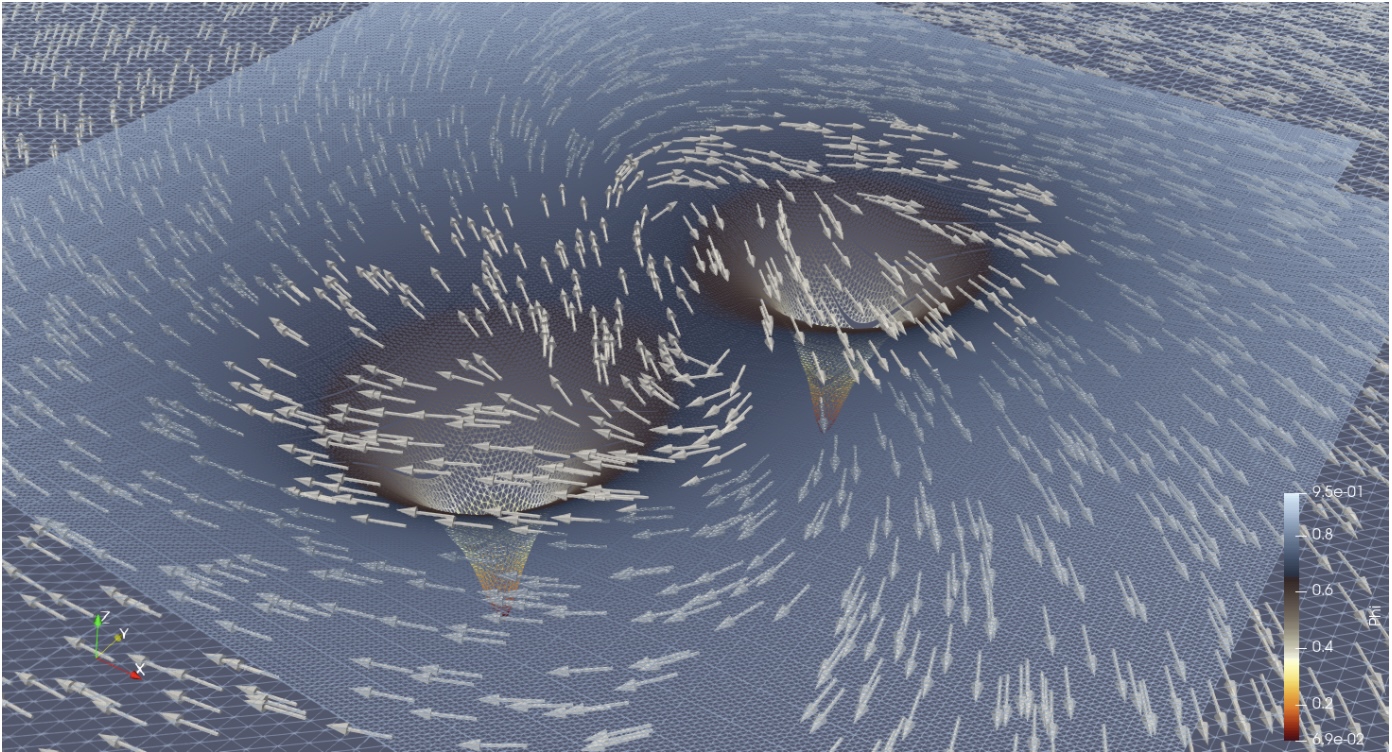 |
| A snapshot of two black holes orbiting around each other, from one of ExaGRyPE simulations. The coloured map represents the spatial configureation of the conformal factor field ϕ, while the arrows indicate the distribution and direction of the shift vector field β. |