Semi-Analytic Galaxy Formation
The GALFORM model takes into account the main physical processes that shape the formation and evolution of galaxies (Cole et al. 2000; see Lacey et al. 2016 for the current version of the model). These are:
- the collapse and merging of DM halos,
- the shock-heating and radiative cooling of gas inside DM halos, leading to the formation of galactic disks,
- quiescent star formation (SF) in galaxy disks,
- feedback from supernovae (SNe), from AGN (Bower et al. 2006) and from photo-ionization of the IGM,
- chemical enrichment of stars and gas, and
- galaxy mergers driven by dynamical friction within common DM halos, which can trigger bursts of SF and lead to the formation of spheroids
Galaxy luminosities are computed from the predicted star formation and chemical enrichment histories using a stellar population synthesis model. Dust extinction at different wavelengths is calculated self-consistently from the gas and metal contents of each galaxy and the predicted scale lengths of the disk and bulge components using a radiative transfer model (see Lacey et al. 2011 and Gonzalez-Perez et al. 2013).
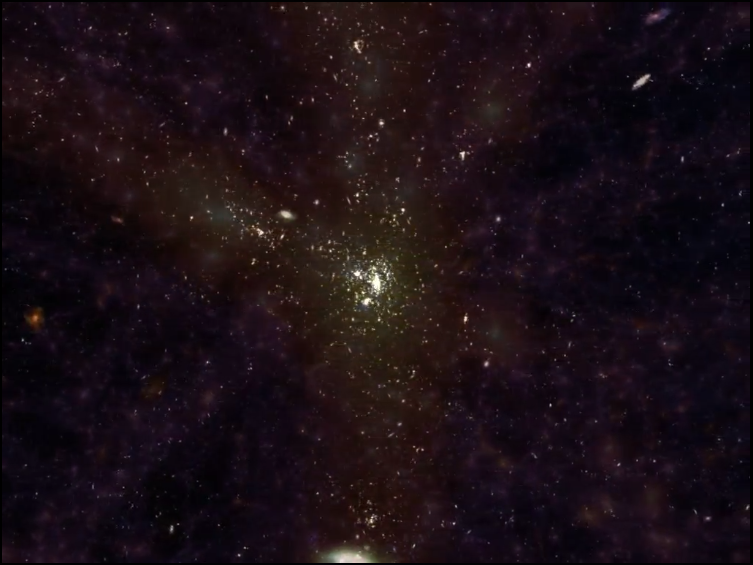

The left hand panel shows the location of galaxies predicted by GALFORM in a region of the Millennium Simulation centred on a massive halo in the dark matter distribution (right)
Recent highlights include:
- A unified multiwavelength model that matches galaxy properties from the far-UV to the sub-mm, over the range z = 0 to z ~ 6 (Lacey et al. 2016)
- Recalibration of GALFORM in the Planck Millennium simulation, and predictions for the atomic hydrogen content of dark matter haloes (Baugh et al. 2019)
- Predictions for deep galaxy surveys with JWST, made five years before launch, including the rest-frame UV luminosity function out to z = 16 (Cowley et al. 2018)
- A test of those pre-existing LCDM predictions against the observed abundance of high-redshift JWST galaxies, showing good agreement out to z ~ 10 without any tuning of the model to the new data (Lu et al. 2025)
- A self-consistent model for the growth of the masses and spins of supermassive black holes, and the resulting AGN luminosity functions for z < 6 (Griffin et al. 2019)
- Emulation of GALFORM with deep learning, allowing the model parameter space to be explored and the model calibrated automatically and reproducibly (Elliott, Baugh & Lacey 2021)
- Forecasts for the surface density and clustering bias of H-alpha emitters in the Euclid and Roman redshift surveys, from a new emulator-based calibration that includes higher redshift data for the first time (Madar, Baugh & Shi 2024)
- A high-resolution lightcone mock tested against the PAU Survey, using the observed colour-redshift relation as a new constraint on supernova feedback (Manzoni et al. 2024)
- A detailed comparison of the physics of galaxy formation in GALFORM and in the EAGLE hydrodynamical simulation (Mitchell et al. 2018)
- The satellite luminosity function of Milky Way-like galaxies, including the contribution of 'orphan' satellites (Santos-Santos et al. 2025)